


How TwinMore enables operational transformation
Transformation shouldn’t just make operations faster – it should make them simpler, more connected and easier for people to execute. TwinMore combines operational transformation expertise with Human & AI Enablement which is about helping organizations remove blockers, simplify complexity and build the operational foundations needed for scalable execution.
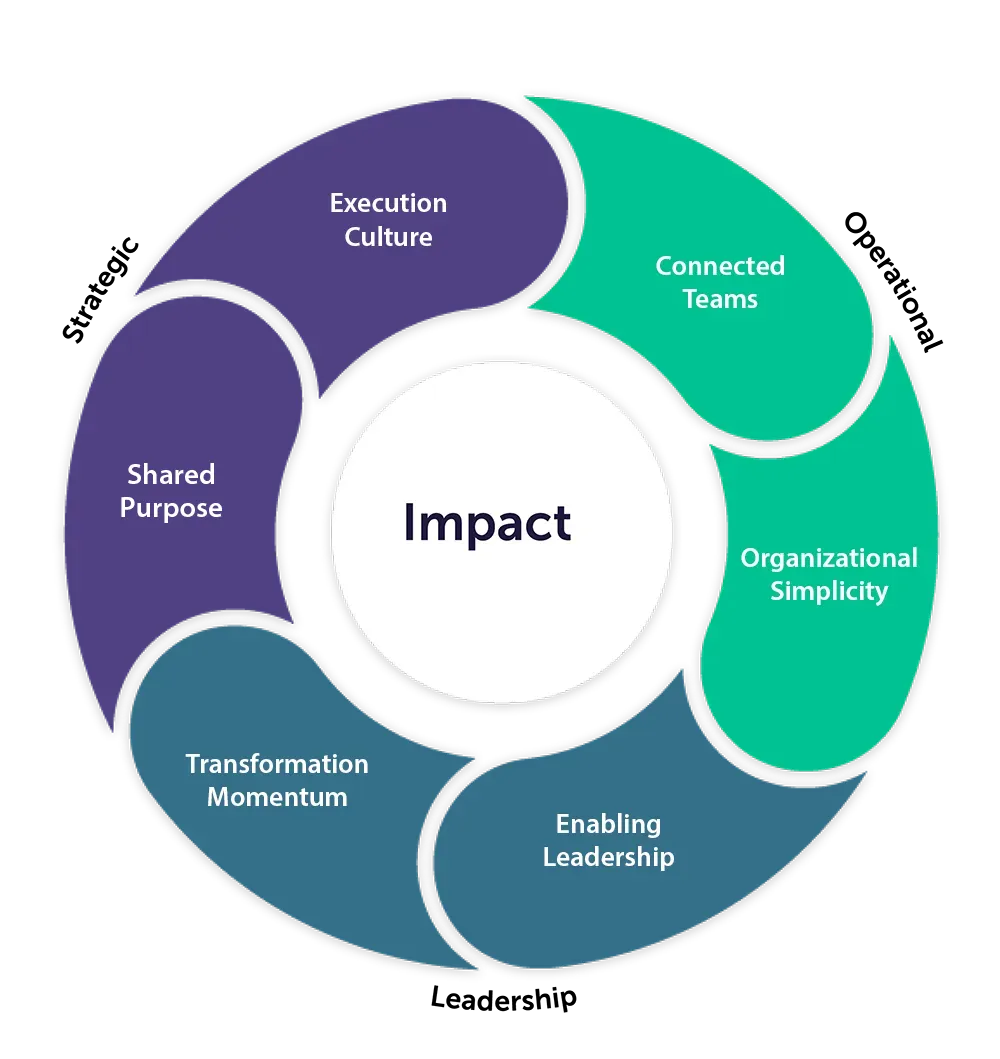
How TwinMore approaches transformation
Most transformations fail because organizations try to modernize technology without simplifying operational complexity first.
Systems evolve separately.
Teams work in silos.
Governance slows decision-making.
AI initiatives scale before operational foundations are ready.
TwinMore approaches transformation through three connected dimensions that enable execution at scale:
- Direction (WHY) – What operational change are we trying to create?
- Foundations (HOW) – How do systems, data and processes enable scalable execution?
- Enablement (WHO) – How do leaders and teams adopt, sustain and accelerate change?
The result:
Transformation that creates operational clarity, execution momentum and lasting capability.
Three dimensions that enable transformation
Too many transformations are technically successful but operationally stuck. Systems are getting implemented. Processes are redesigned. AI pilots are launched. But six months later adoption is low, teams are exhausted, operational friction remains, leadership loses confidence.
What’s missing: Clarity. Alignment. Execution capability.
That’s why TwinMore focuses on all three dimensions simultaneously – because scalable transformation only works when operations, leadership and teams evolve together.
1 - Direction (WHY)
The core question:
Why are we transforming and what operational impact are we trying to create?
What we consider:
- What’s driving transformation urgency?
- Are operational and technology priorities aligned?
- Are initiatives connected or fragmented?
- Does leadership align on outcomes and direction?
- Can teams connect their work to the bigger purpose?
What outcomes we focus on:
Clear priorities, aligned leadership and transformation direction that supports execution instead of slowing it down.
2 - Foundations (HOW)
The core question:
How do we create operational foundations that enable scalable execution without increasing complexity?
What we consider:
- Where operational complexity slows execution down
- Which systems, processes and data flows create friction
- Whether operations are ready for AI and automation
- Where governance and ownership block delivery
- How to simplify before scaling technology
What outcomes we focus on:
Integrated operations. Trusted data. Simplified execution. Strong foundations for AI-enabled transformation.
3 - Enablement (WHO)
The core question:
How do we create an environment where leaders and teams feel ownership and where there is no transformation tiredness?
What we consider:
- Are leaders enabling clarity and fast decision-making?
- Do teams understand how transformation impacts their work?
- Are people equipped and energized to adopt new ways of working?
- Is there enough ownership across teams and functions?
- Can the organization sustain transformation independently?
What outcomes we focus on:
Leaders who create momentum. Teams that adopt change faster. Operational capability that lasts beyond the engagement.
Why operational transformation needs a different approach
There was a moment I stopped focussing on “what is the best approach?” and started sensing: what does this organisation need to change for transformation to become more impactful?
That shift came from years of working on operational transformations where the same pattern kept repeating itself. Organizations invested millions in new systems, launched ambitious AI initiatives and built transformation roadmaps that looked strong on paper – yet execution still slowed down under fragmented priorities, disconnected teams and growing operational complexity.
Technology teams focused on systems. Operations focused on delivery. Leadership focused on pressure, timelines and results. Everyone worked hard, but the gap between “we need to transform” and “we actually made it work” kept growing.
That’s when it became clear: Operational transformation is rarely just a technology problem. It’s an execution problem. Transformation only works when systems, governance, leadership and teams evolve together.
That’s why TwinMore combines operational transformation expertise with Human & AI Enablement helping organizations build scalable execution capability instead of short-term transformation activity.
Why this approach works
Integrated
TwinMore combines operational transformation, Human Enablement and AI readiness into one coherent transformation approach.
Because transformation fails when technology, operations and teams evolve separately
Practical
TwinMore works through focused diagnostics, live enablement sessions and guided implementation support.
No endless transformation programs.
No static strategy documents.
Just focused interventions that create momentum quickly.
SCALABLE
Organizations build internal capability through transformation masterclasses, AI-supported tooling, leadership enablement and operational guidance.
The goal is sustainable execution capability – not dependency on consultants.

The impact of meaningful operational transformation
When organizations simplify operations and enable people toward a shared direction, transformation creates impact on three interconnected levels:
OPERATIONAL EXECUTION
Integrated systems. Trusted operational data. Simplified processes. Better decision-making. AI and automation where they create real operational value.
ORGANIZATIONAL ENERGY
Teams that understand the purpose behind transformation. Leaders who create clarity. Reduced transformation fatigue through focused execution and visible progress.
SUSTAINABLE SCALABILITY
Operational foundations that support future AI adoption, operational resilience and long-term transformation capability.
Ready for transformation that actually works?
Book a discovery call and let’s explore how the Twin Transformation Method can create operational excellence AND organizational energy in your organization.
Frequently asked questions about the Twin Transformation Method
What is the Twin Transformation Method?
The Twin Transformation Method is TwinMore’s approach to operational change. It balances three layers simultaneously: Strategy (why the transformation matters), Operations (how systems, data and processes need to change), and Leadership (how people are equipped to drive and sustain the change). The goal is transformation that works technically and lands organizationally.
Why do most digital transformations fail?
Most transformations fail because they treat organizations like machines: fix the parts, press the button, done. In practice, failure comes from systems that don’t integrate, data that isn’t governed, processes that weren’t simplified first, and teams that weren’t brought along. Technology is rarely the root cause.
What makes the Twin Transformation approach different from traditional consulting?
Traditional consulting often addresses digital and organizational change as separate tracks. The Twin Transformation Method integrates both from the start, combining system integration with team enablement, and linking operational efficiency to sustainability goals. Working solutions are delivered every 8 weeks in a Sprint engagement, not at the end of a program.
What does TwinMore actually deliver in an engagement?
Depending on the engagement, TwinMore delivers strategic assessments, priority roadmaps, leadership alignment workshops, value chain maps, architecture diagrams, sprint plans, agile delivery, leadership coaching, team capability building and knowledge transfer. Outcomes are measured in adoption rates, system integration speed, inventory reduction and service improvement.
How do you ensure teams can sustain the transformation after the engagement ends?
Building internal capability is central to the Twin Transformation Method. TwinMore transfers knowledge, coaches leaders and empowers teams throughout the program, not at the end. The goal is that your teams can sustain and evolve the transformation independently after the engagement ends.